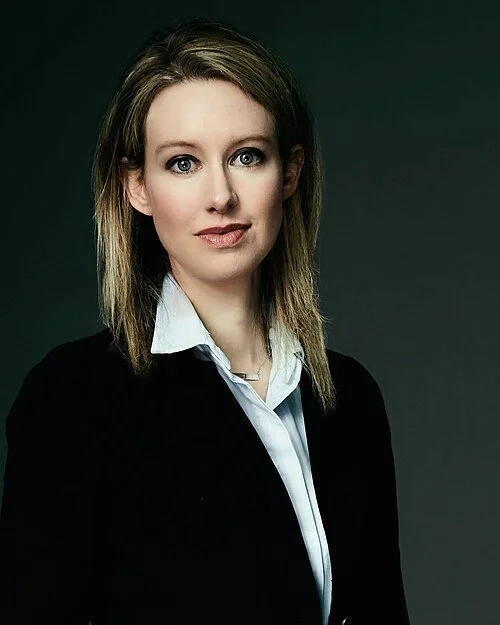
Attribution: Tali Mackay at English Wikipedia
Like so many people, we've been a little obsessed with the Elizabeth Holmes story. The new movie, “You Can See Everything” has only increased that interest even further. The rise and fall of Theranos is a remarkable story. But what stays with me isn't just the money, the famous supporters, or the promises of a medical breakthrough. It's this: How did Holmes persuade so many accomplished people to take her claims seriously when the science behind them raised so many questions?
So, why do we sometimes believe people who are confidently wrong and question ourselves when we have good reason to be skeptical?
Takeaways: 7 Things that the Elizabeth Holmes Story Can Teach Us About Trust and Self-Doubt
1. Confidence isn't the same as credibility. Someone can sound convincing, even when what they're saying isn't true.
2. Even experts can be misled. Intelligence, education, and experience don't make us immune to manipulation.
3. Self-doubt is part of being human. When someone speaks with absolute certainty, we may begin questioning our own knowledge and judgment.
4. Trust should be earned, not assumed. Charisma, authority, and impressive credentials are no substitute for evidence and honesty.
5. Questioning is a strength, not a weakness. Healthy skepticism and curiosity help us make better decisions.
6. Our desire to believe can cloud our judgment. Hope, admiration, and the promise of something extraordinary can make warning signs easier to overlook.
7. It's okay to trust your instincts. When something doesn't feel right, give yourself permission to ask questions, seek evidence, and reconsider what you've been told.
It's easy to watch from a distance and imagine we would have recognized the warning signs. I'm not sure it's that simple. Many of us have met someone whose unwavering confidence caused us to doubt our own judgment, even when their statements seemed inconsistent. Sometimes we walk away thinking, Maybe I'm the one who's missing something.
Our decisions are not solely based on facts. They also reflect our expectations, relationships, fears, and the subtle ways other people's behavior affects us. Understanding those influences can help us become more discerning without losing the ability to trust.
A Doctor Who Had Good Reasons to Be Skeptical
In a November 2026 Psychology Today article, physician and epidemiologist Dr. Jay Varma recalls a video meeting with Holmes and her team in July 2013. Varma was working for the health department of New York City, with responsibility for programs that included the city's public health laboratory.
Theranos claimed it could perform a wide range of laboratory tests using very small blood samples, while making testing cheaper and more convenient. Varma and his colleague pressed for scientific data and information about regulatory approvals. They received assurances, he writes, but not the evidence they requested. The explanation was that the details were confidential business information or “trade secrets.”.
Their scientific concerns remained. Still, Varma found himself questioning his own assessment. Holmes was composed and emphatic. She had influential backers. Could she know something he didn't?
The meeting did not result in an endorsement; Varma's team offered to evaluate the device, but nothing came of it. What makes his account memorable is that he recognized the problems and nevertheless experienced a moment of doubt. His professional knowledge was competing with the impression made by a confident, well-connected person.
We don't need to work in public health or Silicon Valley to recognize that experience.

Why Confidence Can Sound Like Competence
When someone speaks with assurance, it's tempting to assume they know what they're talking about. Often that impression is reasonable. Experience can make people more comfortable discussing their work, and confidence can reflect genuine expertise.
But the reverse isn't necessarily true. Someone can sound completely certain and still be mistaken.
Researchers sometimes refer to our tendency to rely on another person's expressed confidence as the confidence heuristic. Rather than evaluating every detail, we use how sure someone seems as one clue to whether we should believe them.
In a 2013 study, researchers Sunita Sah, Don Moore, and Robert MacCoun found that confident advisers could remain influential even when their advice was inaccurate, particularly when verifying its accuracy was difficult or costly. When people could assess the advice more easily, inaccurate confidence was less persuasive. In another series of studies, Cameron Anderson and colleagues found that overconfident individuals could attain higher social status partly because they appeared competent to others.
Neither finding means confidence is bad. I certainly want a surgeon who understands the procedure they're performing or a pilot who knows how to fly the plane to be confident in what they are doing. The question is whether a person's certainty is supported by knowledge and evidence, or whether we're accepting it in place of those things.
The Shortcuts We Use to Decide Whom to Trust
We make judgments all day long, often with incomplete information. Having to investigate every claim from the beginning would be exhausting. Our brains take shortcuts, and most of the time those shortcuts help us navigate through ordinary life. Three are particularly relevant here.
The halo effect
Imagine meeting someone with a prestigious education, a thriving business, and friends in powerful positions. You might reasonably conclude that the person is accomplished. Without realizing it, you may also begin to assume they're unusually honest, wise, or knowledgeable about subjects far outside their experience.
That's the halo effect: a positive impression in one area spills into our assessment of another. Theranos gained an appearance of legitimacy from supporters whose reputations were impressive, even if their expertise wasn't in laboratory medicine.
Credentials and accomplishments matter. They just don't answer every question. An excellent businessperson may know very little about medical testing.
Authority bias
We're taught from childhood to listen to teachers, doctors, supervisors, and other people in positions of responsibility. Such conditioning is generally useful. The difficulty comes when respect turns into reluctance to ask questions.
They're the experts. Who am I to disagree?
Of course, a specialist may understand something we don't. That's often why we consult one. But asking how a conclusion was reached isn't disrespectful. It's part of making an informed decision, especially when the consequences matter.
Social proof
Suppose you have doubts about an idea, but everybody around you seems enthusiastic. Friends praise it. Colleagues recommend it. Well-known people lend their support. At some point, you may start questioning your own reservations.
Psychologist Solomon Asch explored social pressure in his well-known conformity experiments. Some participants agreed with a group's clearly wrong answer, although others resisted. The experiments indicated that even a straightforward judgment can be affected by what everyone else appears to believe.
In real life, the pressure is rarely so obvious. Sometimes it feels easier to agree than to risk seeming uninformed, difficult, or out of step.

Deputy Secretary of Defense Ashton B. Carter and former Secretary of Defense William Perry sit down for a meeting with Theranos CEO and founder Elizabeth Holmes as they pay a visit to several high tech companies in Palo Alto, California, April 17, 2013. Theranos is a healthcare company focusing on real-time diagnosis and monitoring of targeted ailments in a non-invasive fashion. (DoD Photo By Glenn Fawcett) (Released)
Why Smart People Can Still Be Misled
It's reassuring to think that deception only works on people who are gullible or poorly informed. That would mean intelligence and experience could protect us. Unfortunately, human judgment doesn't work that way.
We bring our hopes and worries into our decisions. Consider someone who has struggled with a health problem for years and hears about a promising new treatment. Or a person offered an investment that might finally bring financial security. The possibility of a good outcome is powerful, especially when people they respect are enthusiastic too.
Questioning the claim may mean giving up something they badly want to believe. That doesn't make them foolish. It makes them human.
There's also a distinction worth keeping in mind: being mistaken, being persuasive, and deliberately misleading someone are three different things. A person may be thoroughly convinced of an idea and still be wrong. Someone else may be convincing because they have done their homework. We shouldn't assume dishonesty simply because a person speaks with confidence.
Nor should we blame people who were deceived for another person's conduct. The useful question is how to make room for careful judgment, especially when an appealing story or a confident speaker makes that difficult.
When Someone Else's Certainty Makes You Question Yourself
Most of us aren't evaluating futuristic medical technology. We're trying to navigate work, family, relationships, and decisions about our health.
Perhaps a supervisor brushes off a concern so firmly that you stop raising it. A partner insists you misunderstood a conversation you remember differently. Or you leave a medical appointment with unanswered questions because the clinician seemed rushed and you would rather not challenge them.
These examples aren't automatically signs of manipulation. People disagree, remember events differently, and occasionally communicate badly. But if your questions are repeatedly dismissed, you may begin to edit yourself before speaking. Instead of deciding what you think, you find yourself trying to predict which answer will be acceptable to the other person.
That's a difficult position to live in. It can leave you feeling uncertain about decisions that once seemed straightforward.
A healthy relationship makes space for disagreement. You can take another person's perspective seriously without setting your own aside. And you can ask for clarification without having to prove that you're entitled to an answer.
The role of anxiety and self-doubt
For people who struggle with anxiety, uncertainty can be especially uncomfortable. A simple decision might trigger a string of questions: What if I'm wrong? What if I've misunderstood? What if I upset someone?
Research has linked difficulty in tolerating uncertainty with worry, particularly in generalized anxiety disorder. For some people, repeated reassurance-seeking or second-guessing becomes a way to manage that discomfort. A confident answer from someone else may offer temporary relief, even if the underlying question hasn't been fully explored.
That doesn't mean anxiety makes a person gullible or that being deceived is evidence of a mental health condition. Anxiety can also make people more cautious or suspicious. Individuals respond differently, and the circumstances matter.
What deserves attention is whether worry is making it hard to decide, speak up, or trust your ability to weigh information. Therapy can help people examine those patterns and practice living with the uncertainty that ordinary decisions inevitably involve.
How to Trust More Thoughtfully
The answer isn't to become suspicious of everyone. We depend on one another's knowledge and goodwill every day. Instead, a few habits can help us notice when confidence is doing more work than it should.
Seek the explanation, rather than focusing solely on the delivery. If someone makes an important claim, ask what supports it. A clear explanation is valuable, but evidence matters more than an impressive presentation. With medical questions, that may include well-designed studies, professional guidance, or an independent assessment.
Check whether the expertise fits. A successful executive isn't necessarily knowledgeable about medicine. A physician can be an excellent specialist without being an expert in every field. Titles tell us something, but not everything.
Pay attention to how questions are received. Someone with sound reasoning should generally be able to explain it, acknowledge limitations, or point you toward reliable information. A dismissive reaction doesn't prove the person is wrong, but it may tell you something about the conversation you're having.
Take time when the decision allows it. Some choices really are urgent. Many aren't. Saying, "I'd like to think about that," or "I'd like a second opinion," is entirely reasonable.
Be willing to change your mind. This works both ways. We shouldn't abandon our judgment just because someone else seems certain, but we also shouldn't cling to an opinion when better evidence comes along. Being open to correction is a strength.
None of these habits guarantees we'll get every decision right. They simply make it easier to pause long enough to think for ourselves.
In Healthcare, Trust Should Leave Room for Questions
This subject matters professionally because healthcare asks people to place a great deal of trust in others, often when they're frightened, exhausted, or dealing with symptoms they don't understand.
Patients deserve recommendations informed by medical knowledge and evidence. They also deserve explanations they can understand, an honest discussion of alternatives, and an opportunity to say what matters to them.
The Agency for Healthcare Research and Quality describes shared decision-making as a collaborative process that brings together clinical evidence, a care team's expertise, and the patient's goals and preferences. To me, that's a useful description of what good care should look like.
At Stillpoint Psychiatry, longer, unhurried appointments provide us the time to listen, ask questions, and work through treatment options together. Psychiatric care is rarely one-size-fits-all. A recommendation needs to make sense medically but also within the context of a person's experiences, concerns, and life.
I don't believe patients should have to choose between trusting their clinician and participating in their care. The two belong together.
Real Confidence Has Room for Doubt
What I keep coming back to in the Holmes story is how someone could project such extraordinary confidence that even highly educated, experienced professionals began questioning their own knowledge and judgment. People who had good reasons to be skeptical found themselves wondering whether they were missing something. It's a fascinating reminder of just how powerful confidence can be—and how easily someone else's certainty can make us doubt what we know
Reevaluating our assumptions can sometimes be the most appropriate course of action. None of us knows everything. We learn from others by remaining open to the possibility that we're mistaken. But openness doesn't require setting aside evidence or ignoring the questions that matter to us.
Perhaps the kind of confidence worth developing isn't the ability to sound certain all the time. It's the willingness to say, "I'm not convinced yet. Help me understand."
If persistent anxiety or self-doubt has made everyday decisions exhausting, professional support may help. At Stillpoint Psychiatry, I provide individualized psychiatric care for adults ages 18-64, with in-person appointments in Hendersonville, North Carolina, and telepsychiatry for patients in North Carolina, Virginia, and Maine.
Schedule a free 15-minute consultation to learn more about my approach and whether Stillpoint may be a good fit.
References and Further Reading
Varma, J. K. (2026, November 4). A Meeting With Elizabeth Holmes. Psychology Today. https://www.psychologytoday.com/us/blog/fevered-mind/202611/a-meeting-with-elizabeth-holmes
Sah, S., Moore, D. A., & MacCoun, R. J. (2013). Cheap talk and credibility: The consequences of confidence and accuracy on advisor credibility and persuasiveness. Organizational Behavior and Human Decision Processes, 121(2), 246-255. https://doi.org/10.1016/j.obhdp.2013.02.001
Anderson, C., Brion, S., Moore, D. A., & Kennedy, J. A. (2012). A status-enhancement account of overconfidence. Journal of Personality and Social Psychology, 103(4), 718-735. https://doi.org/10.1037/a0029395
Asch, S. E. (1955). Opinions and social pressure. Scientific American, 193(5), 31-35. https://doi.org/10.1038/scientificamerican1155-31
Wilson, E. J., Abbott, M. J., & Norton, A. R. (2023). The impact of psychological treatment on intolerance of uncertainty in generalized anxiety disorder: A systematic review and meta-analysis. Journal of Anxiety Disorders, 97, 102729. https://doi.org/10.1016/j.janxdis.2023.102729
Agency for Healthcare Research and Quality. (2023). About shared decision-making. https://www.ahrq.gov/sdm/about/index.html
Medical disclaimer: This article is for general education and is not a substitute for individualized medical or mental health care. It does not attempt to diagnose Elizabeth Holmes or anyone else discussed.